Showing posts with label musicals. Show all posts

Tuesday, June 14, 2011

The Sphinx Winks

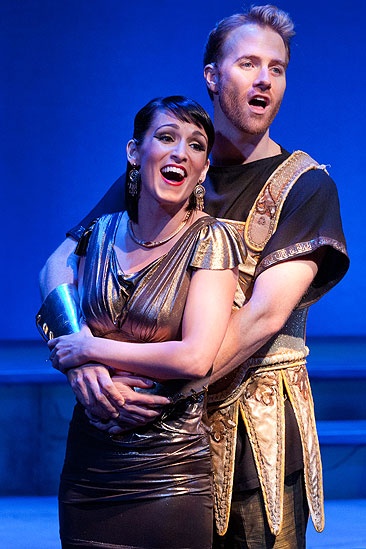
Rebecca Riker and Bret Shuford

No less than five authors are responsible for this 90 minute Burlesque throwback of a musical: book and lyrics by Philip Capice, Anne Hitchner, Kenneth Hitchner, Jr., Robert Keuch and music by Kenneth Hitchner, Jr. According to the program notes this musical was conceived in the 1950s and was formerly three hours long. Now that it finally sees the light of day a half century later it is a blessing that the material has been chopped down to 90 minutes. However, even that is too long, for this trite, unoriginal, unfunny show with a mediocre cast to put it over is a dismal failure. Director Matthew Hamel found some charm in the idea of bringing back this style of show. It has been done much better with FUNNY THING HAPPENED ON THE WAY TO THE FORUM and several of the Rodgers and Hart musicals such as THE BOYS FROM SYRACUSE. THE SPHINX WINKS uses the story of Caesar and Cleopatra as a setting for the fun, but there is not one single attempted joke that lands and not one musical number that can inspire more than dutiful applause for the sake of being polite to a hard working cast that couldn’t possibly save the show. Even if Cleopatra had been played by Donna Murphy, Marc Antony played by Hugh Jackman and Caesar played by Nathan Lane, the material could not be salvaged. To be kind, it should be said that handsome Bret Shuford does well as Marc Antony and multiple roles where he must become ridiculous cartoon characters. He dances well in the only choreographed moment of note with Rebecca Riker as Crecia. Riker partners with Shuford beautifully and both have attractive singing voices. Bruce Sabath as a character man (read lead comedian in Burlesque terms) version of Julius Caesar is proficient, but has little he can do to elevate the part or the show. Erika Amato wears the label of Cleopatra to little effect, though she sings her mundane songs with plenty of spirit and tries her best to adopt a comic persona. Beth Cheryl Tarnow is forced to spend the proceedings performing an irritating gag of singing off key, while Ryan Williams as the host and narrator of the evening fails at delivering one bad joke after another. The high school production level set by Robert Andrew Kovach was all that the material deserved and Gail Baldoni’s rudimentary costumes got the idea across economically. Not one dime should have been put into bringing this show to life, for in the end it was a complete waste of time.


Tifft Productions at The Beckett Theatre through July 24th.

Saturday, June 4, 2011

A Minister's Wife


Lincoln Center Theater presents an odd delight based on George Bernard Shaw’s Candida called A Minister’s Wife. Shaw’s play first appeared in New York in 1903, produced as a special matinee by Arnold Daily who played Marchbanks opposite Dorothy Donnelly as Candida. The reception was so good that additional matinees were added. According to Gerald Bordman in his Oxford Companion to American Theatre, good word of mouth primarily lead to a full run of four months in spite of the critics who largely ignored the play. The love story element has kept the play eternally popular as one of the most often revived of Shaw’s plays. Katherine Cornell stared in the play’s longest New York run of five months in 1924 and she returned to the role often. Some notable names playing opposite Cornell through the years were Orson Wells, Burges Meredith and Marlon Brando.


The play and musical about a woman who must choose between a young visionary and a practical socialist minister is in essence more of a love story than a political statement. In fact the political aspect adds no more than texture to the story, while the passions of love dominate and makes possible the justification for bursting into song. The only truly successful musical adaptation of a Shaw play must be considered My Fair Lady, with Oscar Straus’ The Chocolate Soldier, based on Arms and the Man, coming in a distant second. Now, here is A Minister’s Wife, which will not challenge My Fair Lady for first place, but it should take over second place, though it is a chamber musical and will most likely be produced by small theaters.


As the minister James Mavor Marell, Marc Kudish stands tall––dominating the stage by merely existing. He sings with a strong, but uninteresting voice, yet manages a nice balance between a potentially unlikeable and distant husband with a charming and friendly manner. Eternally youthful Bobby Steggert, who now at age 30 is still able to get away with playing age 20, gives the production its greatest quality of delight as Eugene Marchbanks the poet. Steggert is graced with the best music in the score, and delivers his songs with heartfelt passion. In fact, Steggert has always surged forth to an elevated level of raw, naked emotion in his performances. This is the reason he has been nominated for all the major theatre honors for his past work in 110 in the Shade, Ragtime and Yank. As the title character, Kate Fry, who hails from the Chicago theatre scene, from where this musical originated, is pleasantly durable in the role and sings with grace. She is strong and appealing, but does not imbue Candida with an underlying vulnerability that would make her truly sympathetic. Partially, this is the fault of the adaptation, for in the pairing down of Shaw’s play to accommodate musical numbers (also, the running time is only 95 minutes), some of the complexity of the character is lost. In the supporting roles, Liz Bates as Miss Prosperpine Garnett adds pep and good humor, while Drew Gehling is comically enjoyable as the nebbish Reverend Mills.


Conceived and Directed by Michael Halberstam, the show is economically staged in the three-quarter Mitzi E. Newhouse Theater. Allen Moyers’ simple setting lets us view the small ensemble band through an interior painted scrim. Moyers adorns the smallish space with enough books, nicknacks and select pieces of ideal furniture to make the Minister’s home look well lived in without overwhelming the actors ability to move about. David Zinn’s period costumes are rich with details easily appreciated in the small theater. Keith Parhan’s lighting, though mostly just giving illumination, adds a few haunting touches for the select moments that deserve a bit of magic.


Austin Pendleton has adapted Shaw for Joshua Schmidt’s music and Jan Levy Traven’s lyrics. The songs nicely develop right out of the dialogue, making Marchbanks truly a poet. These are Art Songs with pretty motifs and harmonies, but no discernible tunes. There is nothing here that equals the resplendent melodies found in My Fair Lady and because of that, the score will never become an honored classic or enter the cannon of fifty or so most produced titles of musical theatre. This kind of show will not be everyone’s cup of tea and might even disgruntle fans of Shaw, but on the other hand it is a sturdy, solid, well conceived work and should be able to find its own niche for future productions.

Friday, June 3, 2011

I Married Wyatt Earp


This original musical with a book by Thomas Edward West and Sheilah Rae, lyrics also by Rae and music composed by Michele Brourman, took an all lady look at the Wild West. Cara Reichel had the difficult task of staging eleven actresses on an all too small stage at 59 East 59 Theaters. Worse, Joe Barros was required to supply choreography for several spirited numbers with nowhere to go. Circles became the most useful pattern. Although the songs were appropriate and even had variety, they were woven into a meandering book that didn’t find its focus until the end of the first act. The main action concerned the future Mrs. Earp (Mishaela Faucher) who, being an unconventional teen for her time, runs off with an all lady western tour of H.M.S. Pinafore. The troupe ends up in the town of Tombstone to play an ailing hotel and saloon run by the ladies of the Earp family. The story is told in flashback as an older Josie Earp (Carolyn Mignini) narrates, connects the scenes and argues about the facts and fiction with older Allie Earp (Heather MacRae). The flashback technique, as well as the older versions of the main characters, were unnecessary and the key scenes could have played well enough alone. However, this wouldn’t improve the overall rambling of the plot, which seemed to have as little to do with history as Doris Day’s Calamity Jane––though that would be fine if the material was as entertaining and delightful as that film musical. Structurally poor, musically mundane and only serviceably acted, this new Off Broadway musical was a major miss-fire.


Wednesday, May 25, 2011

The Best is Yet to Come: The Music of Cy Coleman


At the 59 East 59th Street Theaters, presented by the Rubicon Theatre Company, a new revue of Cy Coleman songs brings back a taste of a bygone era of showroom and supper club entertainments. Directed by David Zippel with choreography by Lorin Latarro, the production is the kind that today might be more suited to Casino entertainment than Off Broadway, but Cy Coleman was a Broadway tune smith and so it is appropriate that we should have him back for a short time, if not on Broadway, then very close by. Billy Stritch has created the music arrangements and leads a wonderful eight piece band. He sings a little himself, but the majority of the singing is handled by a stellar ensemble featuring David Burnham, Sally Mayes, Howard McGillin, Lillias White and Rachel York. If Mr. Burnham’s name escapes the memory, he has appeared as Fiyero in Wicked, in the original cast of Light in the Piazza, as well as several national tours. He is the youngster among well known veterans and holds his own singing “I’ve Got Your Number” and “Witchcraft.” Lillias White stops the show with “The Oldest Profession,” which she introduced on Broadway in The Life. Rachel York gives a sultry “Come Summer” the torch treatment sitting upon the baby grand piano and later tears up the stage belting out “Hey Look Me Over.” Howard McGillian, who for the past so many years has been masked as “The Phantom” is looking like an older Cary Grant now, but still sings with that same golden tenor we remember from his Anything Goes and Edwin Drood days. His voice was particularly charming with “I’ll Give the World.” This nightclub entertainment would sit better if it were actually playing one of those elegant rooms of yesteryear, but it is a nice 85 minutes for those who long to hear Cy Coleman sung live by the kind of performers that equal the quality of the compositions. Now through July 3rd. www.59E59.org.

Thursday, May 19, 2011

Lucky Guy


A sparkling new musical comedy, rich with camp, color and plenty of bedazzle by the name of LUCKY GUY, has opened at the Little Shubert. The production is not only directed by, but book, lyrics and music have been written by Willard Beckham. Along with A.C. Ciulla’s spirited choreography, Mr. Beckham has perfectly filled out the Off Broadway stage with a little musical that plays like big Broadway. There is drag performer Varla Jean Merman as a country western star and Leslie Jordan as a show biz used car salesman to gay up an otherwise heterosexual story, handsome Kyle Dean Massey to put over the leading man’s portion of the score, and the ample support of Jenn Colella, Jim Newman and Savanah Wise, but William Ivey Long’s costume design is the real star of the show. The show that boasts such a thing is a vapid show indeed, but fluffy as LUCKY GUY may be, it is thoroughly entertaining, filled with comic surprises and a peppy score.


For what it’s worth, the story centers around Billy Ray Jackson (Dean) who has won a song writing contest advertised on a matchbook, moved to scenic designer, Rob Bissinger’s beautifully ballooned Nashville, to make a hit record with a start up record company. Big Al Wright (Jordan), is promoting his used car lot with a televised show at the Grand Old Opry, featuring the country western star Jeannie Jeannine (Merman). Jeannine hasn’t had a hit record in years and could use a great new song, so the two conspire to steal Billy Ray’s “Lucky Guy” to do the trick. Along the way, Billy Ray falls for the record label’s secretary, Wanda Clark (Wise) even as he is being seduced by Jeannine. Needless to say, the wrongs are righted and everything is tied up in a hasty bow in the last few minutes. The story is flatly insignificant, but it is good enough to support the fun and plenty of William Ivey Long’s inventive costumes.


A great deal of the fun comes from a quartet called The Buckaroos––a group of talented singing and dancing chorus boys (Callan Bergmann, Xavier Cano, Wes Hart, Joshua Woodie) who show up as cowboys, Hawaiian dancers and tap dancing native Americans. As singing hopeful Chicky Lay, Jenn Colella is comic gold, delivering her material like a country western Lucille Ball. As her husband to be, Jim Newman is delightful as a warmhearted record producer on the rise. This second couple might have been used far more, for their talents are immense, but they are lost in the story after the first few scenes. Past incarnations of this show have had an actual female cast as Miss Jeannie Jeannine, but it is difficult to imagine the role being as wonderful without Varla Jean Merman (AKA Jeffrey Roberson) filling the very large pumps, wigs and gowns.


This type of entertainment is the kind of camp-fest that appeals only to certain tastes and will not win over the theater goer who demands a little substance in their musicals, but after a few drinks at dinner, with a group of fun friends out for a diverting evening of mindless musical madness, LUCKY ME is throwing a pretty good party.

Thursday, October 7, 2010

Frog Kiss


This adaptation of the fairy tale THE FROG PRINCE took a bawdy direction, making it a bit of a confusing piece of musical theatre. The jokes tend to be too “adult” for a children’s audience and yet anyone in Western culture would assume they should take their kids to a “Frog Prince” musical. Eric Schorr needs to think about his book with regards to exactly who his audience might be. It isn’t adult enough for adults and it’s too adult for children below middle school. The score by Charles Leipart is fun, but it isn’t unified in style, starting out as a swing score with “Manhattan Transfer” vocals and then engaging in the other styles found at a ballroom competition. If “Ballroom” is the style, then it doesn’t hold together the kooky book. The key elements of the shallow children’s story are in tact and it is the duty of the authors to flesh out the limited characters into three dimensional people and to, perhaps, give reason to the random plot points of the simple tale. This challenge was only half met. The original story teaches the reader to keep a promise. The promise is that the princess must marry the frog. There is a slight ick factor with regards to wedding night issues––an issue discussed among the characters. In the original story a witch casts a spell on a prince, turning him into a frog. The frog insists that he is a prince, but the humans of the story don’t believe him. Finally, after making a deal for the Princess to let him live in the palace and live like the prince he is, the Princess, disgusted by the fact that the frog kisses her, throws the frog against a wall which breaks the spell. Poof! Now he’s a human prince again. In FROG KISS we never get the Witch/Prince back story and so we believe that the frog is just a frog. This only adds to the bestiality subtext.

On the other hand, some of the fleshing out of the story is interesting, such as the Princess going through the various methods of training the Frog to be more human. In the process she finds she is falling in love with the Frog just as he is. Good message, but is she really going to marry a frog? Lucky for all of us the unexplained magic of throwing the Frog against the wall works and he becomes human before the wedding. Another twist is added when Claus (Theis Weckesser), the male character of the second couple, has always longed to “come out” as the frog he truly is inside. A little toss against the wall and his dream comes true, humiliating his wife Hortense (Manna Nichols) in the process. This is supposed to be funny, but it’s a little wacky and prolongs the stretched out material too far without good reason. Also, Claus’ coming out is definitely worked in as a gay story parallel––yet another plot point that doesn’t make sense in a children’s story. Not that this musical, by nature of its source material, has to be for children, but the assumption is naturally there. If the show is really for adults, then it isn’t sophisticated enough. Really, it should find the balance of the best Disney classic films where the humor and treatment of the them registers with adults and isn’t inappropriate for the kids. This is what is meant by “family” musical.

FROG PRINCE was a presentation of the New York Musical Theatre Festival and was nicely produced. The cast was wonderful, with Hanley Smith as a delightful Princess Clementine and the outstanding Curtis Holbrook as the Frog. Holbrook is formerly WEST SIDE STORY’S “Action” and his dancing skill was put to great use. He created an endearing character, both physically and vocally. His presence on stage was so dynamic that it was difficult to take your eyes off him, even when surrounded by the entire cast.

A superb band of six was lead by Daryl Waters. Orchestrations were by Daryl Waters and made the show sparkle. Lorna Ventura choreographed some spirited numbers and used the great talents of Curtis Holbrook to the fullest. Kenneth L. Roberson directed, pulling all the elements together and giving the disjointed material as cohesive a production as could be possible. This was an enjoyable entertainment to sit through, but it is a curiosity and needs a serious rethinking to work the idea into a show that will make sense as family entertainment and as a unified work.

Sunday, October 3, 2010

The Fix


NYU loves to tackle the odd shows and that is wonderful. The overly produced classics are not for NYU. THE FIX (music by Dana P. Rowe; book and lyrics by John Dempsey) is an oddity from London’s West End satirizing American Politics from the perspective of 1997. NYU updated a few references and the story played beautifully as contemporary commentary, suggesting the rise of George W. Bush. With a rock score, the show is a kind of hard core OF THE I SING. The problem with satire is that it’s cynical and without heart. For a musical to really work, pointing out the smoke and mirrors of American politics is not enough, there must be someone to fall in love with, support and root for. All of the characters in THE FIX are despicable, sad or stupid and so it is hard to like a show when you don’t like the people of the story. On the other hand, this college cast was superb. They are a talented bunch, headed by the wonderful Bryan Welnicki as Cal Chandler, the boy who will be made into a President come Hell or high water––that is, if he doesn’t get assassinated for having his own ideas and speaking his mind. John Simpkins directed the production, which entertained quite well in spite of itself. MK Lawson choreographed spirited numbers that kept a static script moving. The score, when sung as well as it was at NYU, was engaging and kept the whole thing energized. THE FIX is interesting––it has something real to say about the hypocrisy of the American political system, it has a score worth hearing and the potential to show off great talents, but it is not a good show. It certainly isn’t satisfying for it only shows the ugliness of humanity and none of the beauty.

Sunday, June 13, 2010

The Burnt Part Boys


At Playwright’s Horizons, home of some of the more amazing small musicals, another new musical treat, coming over from the Vineyard Theatre, was presented in a charming production. This bluegrass operetta has music by Chris Miller, lyrics by Nathan Tysen and a book by Marian Elder. Just where Marian Elder ends and Nathan Tysen begins is a point of confusion, for the libretto is the kind of collaboration where the piece is so unified that it seems as if it had to come out of one mind. In this small theater, Joe Calaroc has simply staged a quest story about three kids who hike many miles through treacherous terrain to reach the Burnt Part Mine. The depiction of this journey is done on Brian Prather’s warm and woodsy set by the movement of several ladders and chairs to break up and change the playing area for every need imaginable––and imagination is the key for we the audience fill in the blanks after the unit set and actors believably create the largely imagined world.

The small cast is not famous, but top notch, with the young Al Calderon playing the 13 year old Pete––protagonist of the story and remarkable star performer of the show. This boy is given half the score to sing on his own and is saddled with numerous emotionally rich scenes that ask as much if not more than the most demanding male roles in musical theatre. The fantastic news is that Mr. Calderon is up for the task and sings and acts the role with an emotional honesty any actor should aspire to. Mr. Calderon is known from the cast of the musical 13 last season and the DVD of the 75th ANNIVERSARY RADIO CITY CHRISTMAS SPECTACULAR. He has a promising future if his past few years of work on stage are any indication.

Pete’s best friend is the geeky Dusty (Noah Galvin) who reluctantly joins the journey along with Frances (Molly Ranson), a runaway tomboy with the smarts to get the group through numerous obstacles. Both render their characters with detail and perform their musical selections with sensitivity and comic aplomb. Pete has stolen some dynamite from his older brother and plans on blowing up the mine to make it impossible to reopen after his father parished there in a cave-in. Charlie Brady plays the older brother Jake and Andrew Durand is his friend Chet, who chase after the kids to stop them from making a big mistake. Rounding out the cast is a small chorus of men who play combination set manipulators, miners and “Greek Chorus”: Randy Redd, Asa Somers and Steve French. Their tight harmonies make the choral music delicious. Michael Park plays a myriad of fictional characters from Pete’s imagination––his boyhood heroes––who show up whenever he needs some advise on which way to turn. A nice duality occurs when after trapped in the mine, Pete’s father comes to him as a ghost––the same actor who had played Pete’s heroes all along. This time all the rest of the group sees Pete’s vision, including Jake, who is able to finally find closure with his father.

The plot serves mostly to cradle the exploration of relationships between the group of friends. Their individual fears, desires, morals and personal goals are challenged with their great sense of community holding them together through a trying ordeal. This is a beautiful little musical, odd in its style and unique in its voice and though its time in New York is now over, hopefully it will rise again in the small professional and community theaters of the world time and again to deliver its sweet heartfelt story.

Wednesday, May 26, 2010

Sondheim On Sondheim


This Stephen Sondheim revue was as much a master class as an entertainment, with some great entertainers illustrating Mr. Sondheim’s lecture. He came in the form of video footage from past TV interviews and contemporary interviews recorded especially for this production. These were displayed on amazing floating TV screens, which moved in a variety of directions like the pieces of a Scrabble game. Behind the menagerie of screens was a small but full sounding orchestra silhouetted like the orchestra from FANTASIA above a rotating maze of stairs and platforms that seemed to create an infinent variety of settings for the lengthy list of musical numbers. Designed by Beowulf Boritt, all of this was beautiful and showcased the talent and the event perfectly. Mr. Sondheim's descriptions of his work, his stories, his shared memories, were all lovely to hear––he is an enjoyable speaker, displaying an intimacy and ease as if we were in his home chatting with him about the history of Broadway––his remarkable experience of Broadway. His experience with Broadway starts with a mentorship from Oscar Hammerstein, writing lyrics for WEST SIDE STORY and GYPSY, then on through his wide variety of musicals for which he composed the music as well as the lyrics: COMPANY, FOLLIES, SWEENEY TODD and A LITTLE NIGHT MUSIC, which is enjoying a revival this season as well. All this and Barbara Cook too! After all the other very fine performers made their entrances, Barbara Cook walked on to an extra round of thunderous applause. There she stood, taking it all in for a moment, a woman who represents the history of Broadway herself. She is the original star of MUSIC MAN, PLAIN AND FANCY and SHE LOVES ME among other things. The past twenty years she has been a busy cabaret and concert star, quite often devoting programs to Stephen Sondheim’s music. I caught one of these at Carnegie Hall some years ago and also saw her in the more intimate Cafe Carlyle. Yes, there she stood, resplendent, now in her early 80s, singing with that clean clear soprano that made “‘Till There Was You”, “My White Knight” and “Ice Cream” so stunning once upon a time. At this performance she gave us brilliantly executed solos of “Take Me to the World”, “In Buddy’s Eyes” and “Send in the Clowns.” We are all so lucky that there is a show for Barbara Cook in 2010.

Of course there are other people in the show too and they are delightful. The other two big stars are Tom Wopat, who has been a Broadway regular for the past decade or so and Vanessa Williams, who had played the Witch in the revival of INTO THE WOODS. As a kind of supporting ensemble, but shining through with solo work as well we were given the powerhouse known as Leslie Kritzer, Norm Lewis who sang a killer “Being Alive,” Euan Morton, who got a lot of comedy material, but who was under used and two fine young singers new to me––Erin Mackey and Matthew Scott. All of these people were charming and sang their material with excellence, both as individuals and as a tight chorus.

James Lapine conceived and directed the production, introducing the audience to quite a bit of rare material. One great use of this idea was hearing the various versions of Bobby’s final song for COMPANY, leading up the the final choice, “Being Alive.” Inbetween hearing these versions, Mr. Sondheim appeared on screen to explain why each version was discarded. This technique was also used to show the evolution of the opening number for FUNNY THING...FORUM––the winner finally being, “Comedy Tonight.” Although I’ve heard Mr. Sondheim tell the story at different times, his telling of the time Oscar Hammerstein signed a picture to him that said, “To Stevie, My friend and teacher,”* was very moving and preceded an emotional “Anyone Can Whistle” being played on the piano by Mr. Sondheim on screen while the cast sang to it on stage. For students of the musical theater, there just isn’t a better classroom to be in than SONDHEIM ON SONDHEIM and by the end of June it will saddly all be over.

*Sondheim fans, I have quoted this from memory, so if I didn’t get it world for word please forgive me.

Friday, April 30, 2010

Closer Than Ever


Out at Queens Theatre in the Park a handsome revival of Richard Maltby and David Shire’s CLOSER THAN EVER gave fan’s of the revered revue a chance to finally see it instead of only hearing it. The popularity of the original cast album has inspired a generation of music theatre writers, but opportunities to see the song cycle live are hard to come by. This new production featured two original cast members, Sally Mayes and Lynne Wintersteller. The supporting men are new to the piece and were ably played by George Dvorsky and Sal Viviano. This middle-aged group is now a little old to sing some of the lyrics pertaining to issues of the thirty-something set, but never the less, the group sold the show with expert performances. A few new songs were added to the program and they were equally welcome along with the good old ones such as, “Doors”, “She Loves Me Not”, “You Want to Be My Friend” and “Miss Byrd.” In the end a song cycle becomes a bit tiresome without a story or regular characters to follow, but for fans of this music, such as the man in the third row who mouthed every lyric right along with the cast, this production made for a fine showcase of Maltby and Shire’s songs. The production was directed by Richard Maltby himself, music directed by Patrick Brady and choreographed by Kurt Stamm. It was co-produced by Bristol Riverside Theatre in Pennsylvania where the show plays after the Queens run.

Saturday, April 3, 2010

BILLY ELLIOT in Chicago


The Chicago Billys


The Chicago production of BILLY ELLIOT at the Oriental Theatre launches the first national tour version and the last production to be personally staged by the original creators. From here on out, this version will be the version, recreated by associates and assistants as the creators move on after a decade of living with BILLY ELLIOT from film to London to Australia to Broadway and now the road. There will be many Billys on the road. The original Broadway boys are already gone and replaced, though Tommy Batchelor has joined the Chicago show after being established as the fourth Broadway Billy. The other Chicago Billys are Giuseppe Bausilio, J. P. Vernes and the actor I saw, Cesar Corrales. Little Mr. Corrales is incredibly charming, a good actor, an adequate singer and a spectacular dancer. He has incredible little dance tricks mixed in to the choreography that are jaw dropping. His tap dancing is ferocious and he is especially fast in his tapping while jump roping moment. As usual for any Billy, his “Electricity” number is a show stopper in the literal sense: the show cannot continue because the audience is too busy cheering and shouting bravos. Cesar Corrales is magnificent.

The anchor of the production is the one Broadway name, Emily Skinner, who is just about perfect as Mrs. Wilkinson. She handles her big numbers with great showmanship, belting out her big notes in signature style and finds several very touching moments when she connects emotionally with Billy. Her reading of Billy’s letter from his mother is particularly beautiful and her good-bye to him at the end is heartbreaking. Armand Schultz is perfectly sound as “Dad,” and he is far less hammy than Greg Jbara on Broadway, though he still manages to get the laughs in the usual places. Cynthia Darlow as “Grandma” is able to move a lot more than Carole Shelley and so her song, “We’d Go Dancing,” has an added exuberance. At the performance I saw, Gabriel Rush played Michael (Keean Johnson from the Broadway show alternates performances), and the character pleases the crowd as usual. Rush has his own version of the usual comic bits and the scene and song, “Expressing Yourself,” just works––as outlandish as it is. Blake Hammond is particularly greasy and eccentric as Mr. Braithwate, which makes him all the more enjoyable a character.

The set, which is more or less the same in all ways, has some key differences. Billy’s stairway to his cage-like bedroom sides out from the side, but the top deck is able to revolve to match the effect during the “Angry Dance” just as it plays on Broadway. The miners aren’t able to descend at the end of the show, and the large union drape simply lowers to fade them out of the picture, though a rear drop of added spot lights mimic the lights on the miners’ helmets, creating the effect of double the people. The metal box that Billy climbs into during the “Angry Dance” is assembled on stage rather than rising from the ground, but otherwise that dance and all the others are exact to the original staging.

This new production is as thrilling as the Broadway and no one is getting anything second rate on the road. Some shows can be diminished on tour, but BILLY ELLIOT plays with equal success and is positioned to astonish the cities of the nation.

Friday, March 26, 2010

Yank

Bobby Steggert and Jeffry Denman

Off Broadway at the York Theatre Company, the musical YANK, which had been popping up here and there in readings, festivals, and a short run with the Gallery Players, finally got the attention it deserved. Named after the military magazine of the same name, YANK is part World Ward II. nostalgia trip and part history lesson––a history you never got in high school. This is a tuneful old fashioned musical in the spirit of Broadway’s golden era that follows the adventures of Stu, an 18 year old private who happens to be gay. He enters the Army feeling totally alone, but soon comes to find out there are hundreds of people just like him in the service. He falls in love with Mitch, a he-man of a soldier who no one would suspect is gay. The two forge a secret relationship, though it is one that is destined for failure. Mitch is too afraid of how to survive the real world as a gay man and chooses a traditional path, but Stu finds the courage to be himself, though it causes heartbreaking traumas along the way. He is befriended by Artie, a reporter for YANK MAGAZINE, who helps him out by giving him a safe job as photographer. Safe, that is, until he and Mitch are discovered kissing by another soldier who reports them and causes Stu to be imprisoned as many gay soldiers were. A lesbian official from the Women’s Army Corps arranges to get Stu released with the choice of going to LA for five years in prison or fighting on the front lines. Hoping to catch up with Mitch, Stu chooses the front lines. After killing three men, Stu lucks out with an honorable discharge and hunts Mitch down in a military hospital in Hawaii. As happy as the reunion is, Mitch cannot imagine a life with Stu as a couple and so Stu flees to San Francisco where he lives out his life, we assume as an open and productive gay man.

The show is musicalized with wonderful harmonies that remind us of the 1940s, but the songs are used in terms of contemporary musical theatre. Many of the songs are up beat with a sense of humor, some are merely for atmosphere, and some are emotionally rich. There is a wonderful group number, “Betty,” where the soldiers all express their longing for their favorite pinup girl and dreaming of home. “Click” shows Artie introducing Stu to gay life, furthering the metaphor of the song’s title with tap dancing. All of the choreography is delightful, including a lovely dream ballet between two men in the second act. Jeffry Denman is choreographer as well as playing Artie.

Stu is a monumental role––asking the actor to go through a roller coaster of emotions, to sing like gangbusters and to tap dance. Bobby Steggert, that wonderful “Mother’s Younger Brother” from the recent RAGTIME revival, proves equal to the task. He is truly wonderful and fills the role as if he had been the character in a former life. Ivan Hernandez is Mitch, singing with a big baritone and dominating the stage with his masculine presence. As tough as his exterior is, he is equally soft and sensitive whenever he is drawn close to Bobby Steggert. Nancy Anderson plays all of the women in the show with the help of many wigs. She serves as an entertaining reprieve from the drama, performing mostly as various radio singers. Her one plot character, the WAC, is an intriguing and contradictory lesbian trying to survive by making herself indispensable to her superiors. The rest of the cast is well played with an energetic ensemble of able voice and dancing skill.

Igor Goldin has directed the production economically on Ray Klausen’s ultra simple set, with a surprising variety of stage pictures that would tell the story alone if you couldn’t hear a line or lyric. Joseph Zellnik is the composer and David Zellnik is the author of the book and lyrics. They have achieved a little bit of amazement: a tuneful, entertaining musical that not only reveals some hidden history, but has something relevant to say about the way humans relate to each other today.

Thursday, November 19, 2009

Memphis


Joe DiPietro (book and lyrics) and David Bryan (music and lyrics) devised a history based story about the early days of Rock ‘n’ Roll as the music genre was created in Memphis.  This slight and highly condensed history shows how white people appropriated the music from black people.  At the center of this story is Chad Kimbal as Huey, a high school drop out who wrangles his way into a radio DJ job––a white guy who starts to play “black” music on the radio.  The white kids go crazy for it the way they swoon over Conrad Birdie in another musical about the early days and everyone starts dancing to the beat together.  The score is made up of original songs that sound like the music of the era and it was nice to hear an original score in a new musical for a change.  This very same story might have been a harness for hits of the 1950s and we’d have another jukebox musical on our hands.  MEMPHIS distinguishes itself by simply being original.  If we don’t learn very much, or even get an accurate picture of the birth of Rock, we do get some electric numbers filled with energetic dancing and some fantastic vocals––mainly from Montego Glover as singer on the rise Felicia.  For all the very real excitement of this musical, the end result of the story is lackluster, with an ending that doesn’t register as completely satisfying, even if an energized finale in shiny gold costumes attempts to spark fireworks.  

Although the history of Rock ‘n’ Roll is the world of the show, the main focus is on Huey’s growing relationship with Felicia––not only a no-no, but illegal at the time.  Huey’s mom (Cass Morgan) doesn’t approve and Felicia’s brother (J. Bernard Calloway) doesn’t approve, but the lovers are going to defy the odds ala GUESS WHO’S COMING TO DINNER.  

The elaborate unit set by David Gallo uses a brick wall and pillars with warehouse windows as the pallet.  On top of this, bits of scenery are added to depict a radio station, night club, kitchen and other locations.  The design is economical, yet rich enough in detail to seem fully realized.  Paul Tazewell’s costumes add most of the visual color and pizzaz to the show and Howell Binkley’s saturated colors of light helped complete the stage pictures beautifully.  Sergio Trujillo’s choreography was such a workout that the heavier members of the cast might find themselves swimming in their costumes after a few weeks in the show.  Most of the dancing depicts nightclub activity or presentational TV or show-within-the-show choreography.  Nothing about the dancing actually serves to push character, plot or story––it’s all just for fun.  The numbers  keep the energy up in an otherwise troubled story and Christopher Ashley’s direction keeps everything moving along with clean precision.  The first act plays with good pace and a forward thrust, while the second act has the feeling of one continuous downhill spiral to the uneventful end.  

MEMPHIS is lucky to be opening in a fall season with no other new musicals with which to compare it.  Under those ideal conditions, MEMPHIS could make it all the way to June and nab a Tony or two.  In another season, MEMPHIS might flounder.  This is a nice show, entertaining really, but missing that special something that makes all the elements come together for something stunning.  Up town in Harlem, the new national tour of DREAMGIRLS has opened as a reminder that another show about the contributions of black artists in the music industry once did it spectacularly right.

Saturday, November 14, 2009

BILLY ELLIOT IS ONE


Happy Birthday Billy Elliot


Last Christmas, friends Scott and Shane chipped in and bought me a very good seat to see the first anniversary performance of BILLY ELLIOT.  In London they had seen that first anniversary, which was a special presentation featuring all three original Billys performing the show at the same time.  We were hoping something equally fun was planned for New York, but it was not to be.  I had at least hoped to see one of the Billys I had not yet seen, such as Tommy Batchelor or the newest Billy, Alex Ko.  Nope, it was good old Trent Kowalik, who I have now seen three times.  Trent was the opening night Billy, so it was appropriate that he would do the anniversary performance.  He is remarkably older looking.  He is lanky now and his voice pops and cracks a bit.  His days as Billy may be coming to an end.  He has some new costumes that do not match the originals exactly––he obviously is growing.  Trent started out as a wee lad in the London production before his year on Broadway.  He was never in a play or musical before BILLY ELLIOT, so the only show he has ever done in his life––his entire acting and singing training––has been his nearly three years in BILLY ELLIOT.  And he has the Tony Award to prove it.  He now exhibits an even greater precision in his dancing and his angry tap dance at the end of the first act is truly stunning.

New to the cast as Mrs. Wilkinson is the Canadian actress Kate Hennig.  She is not as sure of voice as Hayden Gwynne, but she has her own original take on the character and her own specialized wardrobe of crazy ‘80s fashions.  Will Chase, who in real life much too old to play older brother Tony, looks perfectly fine (and perpetually young) on stage.  He gives a good honest performance.  Many of the ballet girls are new, though they have been cast with replicas of the originals.  A new Michael, played by Trevor Braun, has a dozen original bits worked into his character and he is a delightful surprise.  

Even though this performance was not given special treatment for the occasion, it was notable for a few reasons.  In the middle of the dream ballet, the music stopped and the stage manager's voice came over the speakers to tell us they had to stop due to technical difficulties.  Trent Kolwalik and Stephen Hanna (Older Billy) walked off the stage.  One wall of the set had not rolled off into the wings to make way for the flying sequence of the ballet.  Three minutes later the wall started to move out and the black wings dropped in.  Trent Kowalik and Stephen Hanna walked back on stage and took their places.  The music picked up right where they left off as the dance continued.  Trent was hooked up to his fly wire, Hanna thrust him into the air and the audience broke into cheers and applause. It was all, somehow, more exciting for the mishap.  Then there was “Electricity.”  Trent has always done an exemplary job with this show stopper, but now his longer body flies longer through the air, kicks higher to the sky, flips with more force.   And those final twenty Russian turns felt like an Olympian breaking a world record, inciting a roar of excitement from the crowd and a standing ovation.  The woman beside me uttered a word, “Incredible.”  That is just about the size of it.  

Sitting a few seats away from me was the proud grandmother of Trent Kowalik, who was surrounded by a group of fans all chit-chatting with her.  The guy next to me had seen the show twenty-nine times in New York and another six times in London.  He told me his friend, who was sitting down stairs, was seeing the show for the one hundredth time.  I’ve now only seen it five times. I guess I’m not as obsessed with the show as I thought I was.  There is something compelling about certain shows that drive one to keep going back.  BILLY ELLIOT is one that has that power.

Monday, November 2, 2009

Ragtime is back!


When the curtain goes up on the new Broadway production of RAGTIME, there is a collective gasp from the audience.  The triple story set of trusses and iron stairs, representing an outline of Ellis Island or the old Pen Station (take your pick) is dressed with a tableaux of the cast looking picturesque in Santo Loquasto’s beautiful costumes.  Both set designer Derek McLane and the legendary Mr. Loquasto get a round of applause, but maybe it’s also for the show itself.  The design is new, but the image of those characters is familiar, for only a decade ago, RAGTIME made its Broadway debut, losing the Best Musical Tony to THE LION KING.  That production of THE LION KING is still running, but now RAGTIME is back, running on The Street as if it had never gone away.  We need this monumental show just as much now as we did then, to remind us that we are still working at age old issues of being Americans––a so-called melting pot that never really jells.  The issues may not be in exactly the same forms, but for better or worse the media still influences us, we are still struggling with prejudice towards minorities, and justice can feel just as perilous.  This new cast falls just short of matching the masterfull excellence of the original, but they serve the material well.  Leading the way is Quentin Earl Darrington as Colehouse Walker with an excellent voice and a powerful presence.  Christiane Noll, perhaps the only Broadway name of the ensemble, is stellar as Mother and her  “Back to Before” is tremendous.  Stephanie Umoh plays Sarah to perfection and her duet with Darrington, “Wheels of a Dream,” matches the excitement of our memories of the first time we heard it, whether in the theater or on the original cast recording.  I am personally excited to see Bobby Steggert back on Broadway as Younger Brother after his terrific turn in 110 IN THE SHADE a few seasons back.  His singing is full of passion and his infuriated speech to Father (Ron Bohmer) gets exit applause.  Christopher Cox as little Edgar, the host of the show, is darn cute and typical of the little boys who have always inhabited the character.  Yet, his personality is unique and he injects the show with considerable charm.  Marcia Milgrom Dodge directs and choreographs up and around the unit set with good clean movements and original touches that divorce this production from the memorable original, yet honors the intent of the authors.  The result is a welcome return of one of the great shows of the twentieth century, proving itself to be timeless.

Wednesday, October 21, 2009

Finian's Rainbow


With amazing speed after the critically acclaimed concert at the New York City Center, FINIAN’S RAINBOW was scheduled for Broadway and now it is up and running less than a year later. This is a simply staged, old fashioned musical comedy. The simplicity only adds to the beauty of the production, for it is pure, without any unnecessary adornments. The musical theatre has never really needed more than a beautiful score sung well, with a smart design concept that adds to the beauty, but works to efficiently tell the story. All this is true of FINIAN’S RAINBOW. And as old fashioned as it is, somehow the show remains completely contemporary. Political jokes, issues about consumerism and the credit crises, race relations––all of it registers as right now. Along side what seems contemporary are lyrics like, “If this isn’t love, I’m Carmen Miranda. If this isn’t love, it’s red propaganda.” Also, the plot is looney, considering it is about an Irish man who crosses the ocean to bury a leprechaun's pot of gold in American soil in the hopes of doubling his wealth. The leprechaun, Og, has followed Finian to retrieve his gold and out of his element, he is turning more and more mortal every day. There is an obvious romantic plot between Woody, the local hero and Sharon, Finian’s daughter. There is an unlikely second romance between the leprechaun and Woody’s sister, who only speaks through dance. There is a racist Southern Senator who is threatening the harmony of the integrated community of Rainbow Valley. Each of these plot lines weave together and somehow tie up in an idealistic way––which is how we wish the world could be.

Of course, what really makes the whole thing work is a score that contains one wonderful standard after the next: “How are Things in Glocca Morra”, “Look to the Rainbow”, “Old Devil Moon” and on and on. The show contains innovative ideas, such as Susan the Silent dancing to a harmonica solo played by a character who speaks through his harmonica as Susan speaks through her feet. There is the opportunity to show off the great skills of the musical theatre performer, where song, dance and story all work together––it is entertaining, while revealing the beauty of humanity.

Leading the proceedings is the perfect Jim Norton as Finian, who skips and runs and bounces about the stage spreading his joyous brand of insanity. Kate Baldwin is the find of the year as Sharon. She couldn’t be more prefect, for every ounce of her being is one with the character and her voice is glorious. Cheyenne Jackson breathes life into the wooden Woody, but the character is saved mostly by the fact that the authors gave him wonderful music to sing. Still, Jackson and Baldwin make a sexy couple, infusing the candy confection with a little heated passion. Christopher Fitzgerald was born to play Og and is utterly believable in the shoes of a character that is equal parts audacious ham and sentimental heart. As silly as it is, few moments on the stage are as true and heartfelt as when Og wishes over his pot of gold that Susan should be able to speak––and she does.

Down in the pit, Rob Berman conducts the full original orchestration, perhaps the biggest star of the show. Many small characters emerge to give the production color and texture, such as Terri White belting out “Necessity,” Chuck Cooper’s bewildered Senator Rawkins, Alina Faye’s dancing and the harmonica of Guy Davis. Simple beauty all the way around.

Saturday, October 3, 2009

Kiss of the Spider Woman at NYU


The main thing that one comes away with from the NYU Steinhardt production of KISS OF THE SPIDER WOMAN is that there is a large group of talented young men who all have a career if they want it.  The female population of the “Program in Vocal Performance” must be a little miffed this semester, for the show only has three roles for women.  The rest of the cast, lead by two powerful singers, Jordan Stanley as Molina the window dresser jailed for “corrupting a minor” and Roy Richardson as Valentin the revolutionary, is all male and collectively amazing.  The choral singing alone gives goose-bumps, especially the spine-tingling rendition of “The Day After That,” a triumphant rally for hope.  Stanley plays the fey stereotype with plenty of dignity and beautiful singing.  His voice is immensely expressive and he rules the production.  Richardson is equally confident of voice, and although the role is less showy, he should match his costar with his own brand of bravado, but does not.  As the title character, Lauren Calhoun, is appropriately South American and exotic. Her voice can capably handle the low keys designed for the original Spider Woman, Chita Rivera, and also lighten up certain areas that bring a new loveliness to the score.  This Spider Woman is less of a dancer than Ms. Rivera’s, but Jennifer Werner’s very original choreography finds effective ways to move her around gracefully and the ensemble men manage some complicated moves with both power and grace on a stage cluttered with scaffolding and moving gates.  The clutter, dominated by a rotating raised platform at center, was designed by Michael Schweikardt and director John Simpkins has some difficulty working around it.  The center platform, however, makes a nice mini-stage to present what is really a very small play about two people from different worlds locked in a cell together.  How they get to know and appreciate each other is the heart of the story, but the Spider Woman and her dancing back up boys give the show it’s musical flash.  The show itself emerges as a kind of lost treasure.  The score by Kander and Ebb is lush and full of melody.  It does not sound anything like CABARET or CHICAGO and maintains its own special flavor, specific and appropriate to the subject matter.  There are stunning images, strong commentary on the cruelty of human beings towards one another, but counterbalanced with a search and discovery of the good will in men.  KISS OF THE SPIDER WOMAN is one of the great shows of the 1990s, it should be reexamined more often.  NYU took on the challenge with fantastic results.

Monday, August 31, 2009

CATS


Excursion to California


At the time I left my eleven season stint at the Sacramento Light Opera (home of the Music Circus and then, Broadway Series), a lot of change had occurred to that company.  The organization was started in the ‘50s as one of many outdoor musical theatre stock summer companies.  The shows played in the round under a tent.  As the years went on, the tent was moved to a more spacious portion of the block at 15th and H Streets with a bigger stage and increased seating capacity to about 2400.  I worked in various capacities with the organization from 1989 to 2000 before moving to New York.  At the time I left, plans for a new permanent theatre building were underway and two seasons later the new facility was up and running.  The new building had an improved stage, improved lighting grid, real theatre seats with ample leg room and air conditioning.  The organization’s name was changed to California Musical Theatre with the summer season still known as Music Circus and the winter presentation of tours renamed Broadway Sacramento.  I have been back a few times to check in on the old stomping grounds and in August I caught the production of CATS.  It was more or less the same old CATS, with the Broadway choreography reconfigured for the round.  The costumes are recreations of the original design and the show featured cast members from the Broadway run, most notably, Ken Page, the original Old Deuteronomy.  Also, Jeffrey Denman, who was Broadway’s closing night Munkustrap, was reprising his role here.  The production was definitely entertaining, but it is difficult for me to get too excited about CATS.  Even when I first saw it in San Francisco in 1986, I was a little surprised at how random it was.  Like many, I was trying to work out a story as I was watching the first act.  When you try that, you get very discouraged.  Once I realized it was no more than a revue about different kinds of cats, I was able to enjoy the second half for what it really was.  Even so, there is not enough to the show that really does it for me––save for its one truly great moment when Grisabella sings “Memory.”  Jacquelyn Piro Donovan (famous for being the only actress to play both Cosette and Fantine in Broadway’s LES MIZ) belted the hell out of the hit song, sending the audience into a frenzy of cheers.  The Music Circus remains the greatest cultural jewel of Northern California next to the city of San Francisco.  The following night I volunteered to help work a benefit show staring Carol Channing, but that’s another story.

Tuesday, August 11, 2009

9 to 5


9 to 5


Poor 9 TO 5––it didn’t deserve to close so early and it didn’t deserve all of the unfavorable reviews.  The truth is that it is a good representation of he kind of musical that will be identified with the first ten years of the new millennium.  This is a new musical, with a new score (at least the score was actually original, save for the title song), by a celebrity recording/song writing star, based on a hit movie (some of them are based on less than a hit movie).  Screenwriter Patricia Resnick, who also handles the book for the musical, had ideal material to harness Dolly Parton’s songs.  Although the score doesn’t emerge as better than serviceable, it has some fine moments and it really does serve the story.  In fact, it works the way all of the elements of this musical work: slick, clean, ever-moving and with plenty of charm.  A great deal of the charm factor comes from the outstanding three leading ladies who elevate the show above its merely serviceable structure.  Allison Janey as Violet is basically perfect.  She doesn’t challenge our vision of the character as established by Lilly Tomlin and so she’s comfortable, but she also commands the stage and makes the part her own.  Megan Hilty is a replica of Dolly Parton as Doralee and this is obviously by design.  It is also clear that Ms. Parton has shown the most affection for this character, giving her the best songs in terms of character development.  It is clear that Parton is writing autobiographically.  Stephanie J. Block as Judy, the role made famous by Jane Fonda, is nothing like Jane Fonda, but is everything Judy should be.  This is the one casting choice that didn’t smack of the movie at first glance.  Parton has also given her a terrific powerhouse number to show off Block’s formidable belt and at the same time, brilliantly musicalize the character’s breakthrough moment of taking charge of her own life.  The song is “Get Out and Stay Out” and it is a show stopper placed in the spot reserved for the traditional “Eleven O’Clock Number.”  

In its own stylized way, the office set by Scott Pask attempts a kind of realism, but other scenes outside the office can be rather suggestive.  What in the era of THE PAJAMA GAME (a second cousin to this show) would be painted drops, is now projected graphics.  Sometimes they are animated, sometimes they complete the setting of the three dimensional elements that travel in on wagons.  The look is contemporary technology through a LIFE magazine ad of 1980. William Ivey Long’s costumes are not the usual glitz and glamor we are used to from him, but then he’s been completely appropriate to the show and the era.  A fantasy sequence allows him to go a little wild, though he takes his cue from the movie.  Amazingly, the hair design by Paul Huntly and Edward J. Wilson is particularly good, evoking the women’s hairstyles exactly, down to each chorus member.  Even the men’s hair was the right length.

Somehow Joe Mantello directed this un-inventive entertainment in the same season where he directed the rather innovative revival of PAL JOEY.  Andy Blankenbuehler choreographed the show within an inch of its life, which is remarkable when you consider how unsuited to dance the story is.  Outside of the fantasy sequences where a little dance is not only expected, but demanded, the rest of the choreography is given to chorus people making crosses in front of set changes.  This idea was a throwback to the 1920s when a line of chorus girls came out before a drop “in one” for no reason but to entertain the crowd while the big set shifted.  

Shortcomings aside, the show was rather delightful on the whole.  The featured players were completely winning, the script was very funny––even the most familiar jokes from the film played to big laughs.  The crowd seemed to enjoy the show for the rollicking romp it was intended to be.  Isn’t this the case for most of the musical theatre through history?  This kind of show not only has its place, it represents the meat and potatoes of the genre.  Only once in a while does SHOW BOAT, MY FAIR LADY, GYPSY, RAGTIME or BILLY ELLIOT spring forward to surprise us and prove that the musical can be one of the most powerful and affecting art forms. Most of the time it’s LEGALLY BLONDE, FULL MONTY and MAMMA MIA.  9 TO 5 fits in and has its place.  One thing is for sure, the title is licensing gold, so you can fully expect this female centric musical to permeate the community theatre, and high school musical market.

Saturday, August 8, 2009

Off The Radar


I am often at numerous readings and short fringe theatre runs.  These things come and go and play to a very small audience, yet make up a rich part of the New York theatre scene.  Here's two interesting things seen recently:

Chimes


It has been six years since the Summer Play Festival (SPF) began with an ambitious eighteen plays, a number which has been whittled down to eight for 2009.  This number much more manageable, since unlike other New York theatre festivals, SPF produces all the plays from scratch––design work and all.  The past two years SPF has been housed at the Public Theatre and friend Andy Phelan was starring in a very good play by Kevin Christopher Snipes called CHIMES.  The title refers to the name of a club of teens at an all boys school in Massachusetts who love their Shakespeare.  This is a kind of memory play where older actors watch their younger selves and relive cherished experiences––some good, some bad, all worth it.  During the course of a series of flashbacks, the older characters purge themselves of their demons.  It might not have been necessary to even bother with the older characters, for the coming of age story was interesting enough.  Still, the older characters, namely Nick Ross (Richard Bekins as the older version and Andy Phelan as the younger), are withholding something and so as we get each episode from the past, a little more is revealed until we get the full story––adding a level of suspense.  The play is set just before World War II., but in these modern times, the revelation that two of the boys fall in love is almost expected––the play was heading there from the beginning.  The slight surprise is that it is not the coupling one might expect after all.  

However, a much bigger issue was more striking.  One of the professors finds the famous speech from THE MERCHANT OF VENICE (“If you prick us do we not bleed?”), morally objectionable because he is anti-Semitic.  The leader of the boys (played beautifully by Jeff Ward), argues that the speech is the center and purpose of the entire play and that it must be said.  He goes on to give the speech in a heated delivery and it was stirring.  The bigoted egomaniac of a professor firmly orders that the speech will be cut.  So, the boy plots to sneak the speech back in opening night, facing expulsion from the school.  What is really moving about CHIMES is the way the teens are so stuck under the rule of their elders.  These are intelligent young men, being taught by intolerant adults who hold all the power of their existence.  It is nearly impossible for the boys to fight against the institution they are jailed by and so, in the end they do not succeed.  Something is being said here about an older generation’s inability to actually do what is best for their children, which in this case is to not allow them to develop their own humanity.  This all sounds pretty rough, but the play was filled with humor and the joy of camaraderie, which went a long way to balance out the horrible plight of the boys and the negative ramifications it brought to their adult lives.  

Also featured as the teen cast was Brian Charles Johnson as Birdie, who is an original cast member of SPRING AWAKENING, and a gregarious and entertaining performance by Elan Moss-Bachrach as Vivian Porter.  The adults were all perfectly suited to their roles, the older versions of the boys looking quite like their young counterparts, with John O’Creagh as older Birdie and Graeme Malcom and Peter Van Wagner as the faculty. Andy Phelan continues his career as a teenager several years past his own ten year class reunion, but he is perpetually young and astonishingly believable as a seventeen year old to this day.  He was ideal for the role and his maturity as an actor only brought a depth of character that it might not otherwise have had.  Truth be told, Andy has played this character many times and it is like rolling out of bed for him––literally in this case.  Here’s hoping he gets to graduate from high school before he’s forty.  

The photo is of Andy made for a prop in a period play of my creation, A TASTE OF HEAVEN, which played the NYC Fringe Festival in 2003.  He pretty much looks exactly the same today.


999 B.C.


On assignment for MTI, I attended a reading of a new musical at the York Theatre Company based on the bible story of Jonah and the whale.  The York will present up to forty readings a year, choosing a lucky few for their regular season of full productions.  At this beginning stage, it is hard to know what will become of 999 B.C., for it doesn’t spring forth and grab you, yet it is generally entertaining and the score is bouncy and fun.  The show depends on the general humor that comes from an audience knowing they are seeing a biblical tale and then getting a campy send up of the traditional story, full of out of place modernisms and a jazz score that just doesn’t fit into the biblical box.  Bob Larimer has fashioned the book and lyrics using 1940s jazz standards by Neal Hefti, Ernest Wilkins, Charlie Parker and others.  The songs are the best element, with a so-so book, containing only a few really brilliant jokes, but an otherwise tongue-in-cheek diversion of the original tale.  If you aren’t up on your bible stories, this is the one that reminds you of PINOCCHIO, for when Jonah denies God’s instructions, he is fed to a whale.  999 B.C. makes quite a lot out of the surrounding plot of this main event, but the details of the original story are scant.  Mostly, the story of Jonah is a jumping off place for fun, but I’m not sure what we’re supposed to gain by the shenanigans.  A full staging might complete the experience and turn the whole thing into a kind of cousin to SPAMALOT.

The reading was filled with some wonderful performances.  Todd Buonopane as Philo, the narrator and lead comic of the piece, was delightful in his general exuberance and joy.  Cole Burden made Jonah a working class romantic leading man and sang well alongside the naturally funny Keven Reed as his sidekick Joel.  The rest of the cast turned in energetic performances with strong singing, but the youngest of the cast, Jacob Pinion, stood out, playing multiple little roles with a fresh and funny character every time.  He was a hoot and the real comic genius of the production.  It wasn’t that his material was particularly funny––he made it so.  Young Mr. Pinion is only just out of NYU.  Watch for his name, for I bet that he will emerge into a major talent.